Introduction to Computer Vision

cse 327, spring 2012
T/Th 2:20-3:40 in Soc. Behav. Sci. S328
Instructor: Alex Berg
aberg at cs. "yourschool" .edu
Office Hours T/Th 3:40-5:20 Rm 1418 Computer Science Building

Required Textbook: Computer Vision:Algorithms+Applications, by R. Szeliski

Grading 40% reading, attendance, and participation, 20% homework, 20% mid-term, 20% final project, no final exam. 3 "slip days" on homework, otherwise no credit for late assignments.
Computer vision is the most effective way to acquire information about the world directly around us. Developments like cameras on cell phones and the 3D Kinect sensor are making computer vision applications ubiquitous. This course will introduce the basic ideas in computer vision, provide experience with algorithms for sensing the world using computer vision, and will include labs/assignments using the kinect sensor. See the first lecture for course contents. All are welcome. Please see or e-mail the professor with any questions!

Course flyer
    Lectures:
  • Jan 24   Introductory lecture. pdf. Try out matlab, read the first chapter of the textbook for next lecture.
  • Jan 26   lecture 1 pdf. Try out matlab, read the second chapter of the textbook for next lecture.
  • Jan 31   lecture 2 pdf. Homework #1, due Feb 9. See end of lecture 2 notes and look here for starter matlab code. See here for the images.
  • Feb 2   lecture 3 pdf. Re-read chapter 2 in the text.x
  • Feb 7   No class. Instead attend the awesome cDACT talks, especially Andreas Velten @ 5pm on Friday talking in the Simmons Center on Capturing Light in Motion!
  • Feb 9   lecture 5 pdf. Guest lecture from Prof. Dimitris Samaras, Stony Brook University. Homework #1, due today.
  • Feb 14   lecture 6 pdf. Read chapter 14
  • Feb 16   lecture 7. Introduction to classification and detection. Reread chapter 14.
  • Feb 21   lecture 8. Walkthrough of building a classifier based detector Homework 2 due March 1 -- for next class get the detector training setup and begin making your homework web-page with intermediate results. Sample images and code here.
  • Feb 23   lecture 9. Walkthrough of building a classifier based detector II. work on getting sliding window detection / retraining to work for next class
  • Feb 28   lecture 10. Walkthrough of building a classifier based detector III. work on finding "hard negatives" and using them for reraining
  • March 1   lecture 11. Walkthrough of building a classifier based detector IV (non-max suppression). Homework #2 is due today.
  • March 6   lecture 12. Histogram descriptors and panoramas. Read section 1 of Chapter 6. Look up David Hockney.
  • March 8   lecture 13. Types of Panorama's and Montages, correspondence problems, and least squares optimization.
  • March 13   lecture 14. Midterm review, photosynth, demo of first part of next assignment. First part of assignment 3 due Tuesday March 20 -- Make a tool to explore correspondences between images, implement SSD on vectors of pixel values and histograms of gradient directions. Sample code here.
  • March 14   lecture 15. Study period
  • March 20   lecture 16. How to setup least squares fitting to find affine alignments. Second part of assignment 3 due before Thursday March 29 -- Select a pair of images, mark 10 corresponding points in the images, use least squares fitting to find an affine transformation between the points, warp one image to line up with the other, and display them, averaging the overlapping pixels. Sample code for least squares fittinghere.
  • March 22   lecture 17, variations on fitting and alignment.
  • March 27   mid-term.
  • March 29   Kinect demo and discussion, form groups for final project. Sample kinect code here.
  • April 3   Spring Break
  • April 5   Spring Break
  • April 10   Estimating geometry with the kinect.
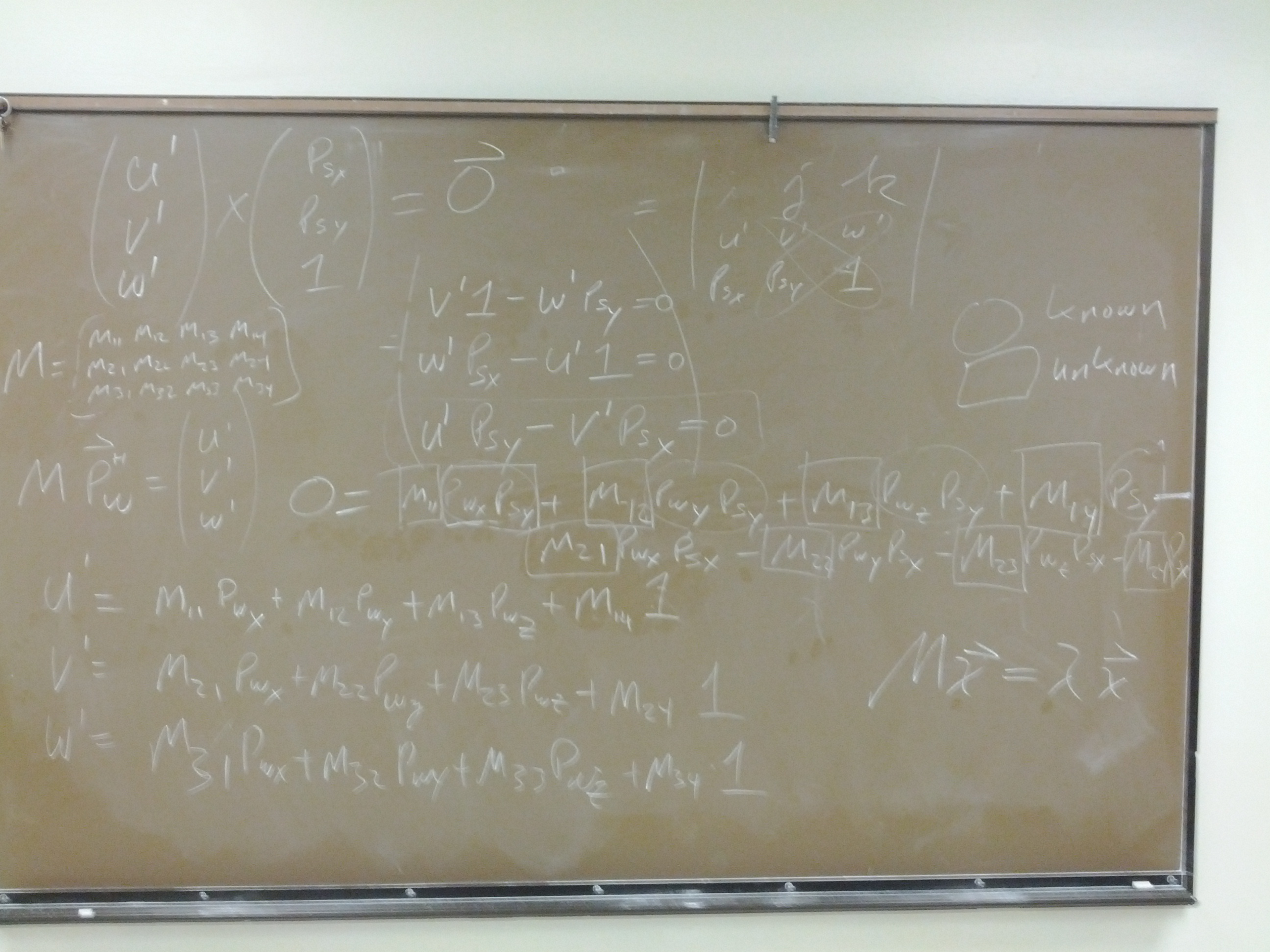
  • April 12   Camera calibration. See some photos of the blackboard 1 2
  • April 17   Camera calibration.
  • April 19   Camera claibration and demo of how the assignment should look.
  • April 25   Introduce remapping textures.


  • Stony Brook University Has policies for students here
    In addition the following are required to be posted for all courses:
      Americans with Disabilities Act:
        If you have a physical, psychological, medical or learning
        disability that may impact your course work, please contact
        Disability Support Services, ECC (Educational Communications
        Center) Building, room 128, (631) 632-6748. They will determine
        with you what accommodations, if any, are necessary and
        appropriate. All information and documentation is confidential.
    
       Academic Integrity:
        Each student must pursue his or her academic goals honestly and
        be personally accountable for all submitted work. Representing
        another person's work as your own is always wrong. Faculty are
        required to report any suspected instances of academic
        dishonesty to the Academic Judiciary.  Faculty in the Health
        Sciences Center (School of Health Technology & Management,
        Nursing, Social Welfare, Dental Medicine) and School of 
        Medicine are required to follow their school-specific 
        procedures.  For more comprehensive information on academic
        integrity, including categories of academic dishonesty, please
        refer to the academic judiciary website at 
        http://www.stonybrook.edu/uaa/academicjudiciary/
    
       Critical Incident Management:
        Stony Brook University expects students to respect the rights, 
        privileges, and property of other people. Faculty are required
        to report to the Office of Judicial Affairs any disruptive
        behavior that interrupts their ability to teach, compromises 
        the safety of the learning environment, or inhibits students'
        ability to learn.  Faculty in the HSC Schools and the School of
        Medicine are required to follow their school-specific 
        procedures.